
News
The Backrooms: A Modern Urban Legend and Its Place in Horror Culture
Jun
Introduction
In the age of the internet, horror stories no longer spread only through books, movies, or campfire tales. Digital culture has given rise to entirely new forms of fear, and few examples are as influential as The Backrooms. What began as a simple image posted online evolved into one of the most recognizable modern urban legends and creepypastas of the 21st century. Unlike traditional ghost stories or monster tales, The Backrooms taps into deep psychological fears, creating a unique form of horror that resonates with millions of people worldwide.
This article explores the origins of The Backrooms, analyzes why it is so effective as a horror concept, and compares it with other horror genres to understand its lasting impact on internet culture and modern storytelling.
The Origins of The Backrooms
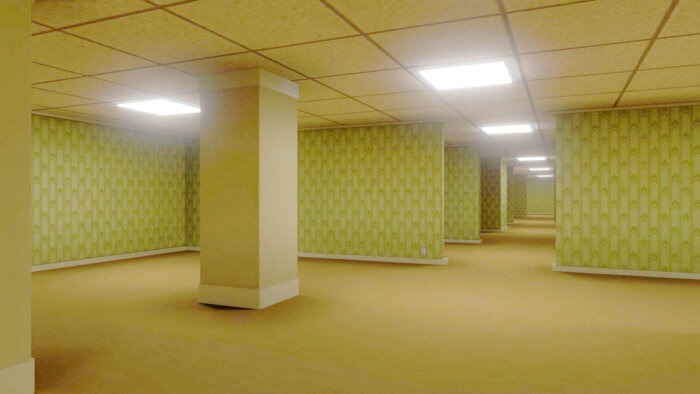
The Backrooms first appeared in 2019 on the online forum 4chan. A user posted an image of an empty office-like space with yellow wallpaper, fluorescent lighting, and stained carpeting. Along with the image came a short description:
“If you’re not careful and you noclip out of reality in the wrong areas, you’ll end up in the Backrooms.”
The concept was simple but powerful. According to the story, a person can accidentally slip through reality itself and become trapped in an endless maze of identical rooms. There are no windows, no exits, and no clear understanding of where the space begins or ends.
The term “noclip” comes from video games, where players can pass through walls and objects due to cheats or glitches. By applying this concept to reality, The Backrooms created a terrifying possibility: what if reality itself had bugs, and people could accidentally fall through them?
Why The Backrooms Is So Frightening
The Fear of Liminal Spaces
One of the most important aspects of The Backrooms is its connection to liminal spaces.
A liminal space is a transitional environment—a place that feels familiar but strangely empty or abandoned. Examples include:
- School hallways after hours
- Empty shopping malls
- Deserted office buildings
- Hotel corridors late at night
These locations create discomfort because they appear normal but lack the people and activity we expect to find there. The Backrooms amplifies this feeling by presenting an endless world made entirely of liminal spaces.
The Fear of Isolation
Most horror stories involve a threat that can be identified. It might be a ghost, a demon, or a serial killer.
In The Backrooms, the greatest threat is often isolation itself.
Imagine being trapped in a place where:
- No one can hear you
- No one knows where you are
- There is no clear escape
- Every room looks the same
The fear comes not only from what might be lurking in the shadows but also from the realization that you may never find your way out.
The Fear of Meaninglessness
The Backrooms also touches on existential fears.
Traditional horror often offers explanations. There may be a curse to break, a monster to defeat, or a mystery to solve.
The Backrooms offers none of these comforts.
There is no obvious purpose, no clear rules, and often no explanation for why the place exists. This creates a sense of cosmic insignificance, making the experience feel deeply unsettling.
The Expansion of The Backrooms Universe
What started as a single image quickly grew into a collaborative online mythology.
Fans created:
- Hundreds of new levels
- Unique entities and creatures
- Survival guides
- Maps and theories
- Entire stories set within the Backrooms
The original yellow rooms became known as Level 0, while countless additional levels were added over time.
Some famous examples include:
Level 0
The iconic endless yellow office maze.
Level 1
A darker industrial area with concrete walls and mechanical sounds.
The Poolrooms
A surreal environment filled with endless swimming pools and calm blue water.
Level Fun
A deceptively cheerful area associated with dangerous entities known as Partygoers.
This community-driven expansion transformed The Backrooms into a massive fictional universe.
The Kane Pixels Phenomenon
In 2022, a young filmmaker known as Kane Pixels released a found-footage-style Backrooms video on YouTube.
The video quickly went viral.
Unlike many internet horror projects, Kane Pixels focused on:
- Realistic camera movement
- High-quality CGI
- Atmospheric storytelling
- Minimal jump scares
His work introduced The Backrooms to a much larger audience and demonstrated the cinematic potential of the concept.
The success of these videos eventually led to plans for a feature film adaptation, proving that an internet urban legend could become mainstream entertainment.
Comparing The Backrooms to Other Horror Genres
The Backrooms vs. Supernatural Horror
Examples:
- The Conjuring
- Insidious
- Annabelle
Supernatural horror typically focuses on ghosts, demons, and paranormal activity.
The Backrooms is different because its horror comes primarily from the environment rather than a supernatural entity. Even when creatures are present, the setting itself remains the most frightening aspect.
The Backrooms vs. Slasher Horror
Examples:
- Halloween
- Friday the 13th
- Scream
Slasher films rely on physical danger and violent killers.
The Backrooms rarely depends on violence.
Instead, it creates tension through:
- Uncertainty
- Loneliness
- Endless exploration
- Psychological dread
This makes it a slower but often more unsettling form of horror.
The Backrooms vs. Cosmic Horror
Examples:
- H.P. Lovecraft’s works
- The Cthulhu Mythos
Both genres share a fear of the unknown.
Cosmic horror emphasizes humanity’s insignificance in an incomprehensible universe.
The Backrooms achieves a similar effect but in a more relatable setting. Instead of ancient gods and alien dimensions, it uses office hallways, fluorescent lights, and empty rooms to create existential dread.
The Backrooms vs. SCP Foundation
The SCP Foundation is another internet-born horror phenomenon.
Similarities include:
- Community-created lore
- Multiple entities and locations
- Expanding fictional universe
However, SCP focuses on cataloging anomalies through scientific reports and documentation.
The Backrooms focuses on immersion, atmosphere, and the emotional experience of being lost.
The Backrooms vs. Analog Horror
Examples:
- Local58
- Gemini Home Entertainment
- The Mandela Catalogue
Both genres became popular through online video platforms.
Analog horror often uses distorted television broadcasts, VHS tapes, and corrupted media.
The Backrooms instead centers on distorted spaces and impossible architecture. One explores fear through broken communication, while the other explores fear through broken reality.
Why The Backrooms Became So Popular
Several factors contributed to its success.
Simplicity
The core concept is easy to understand:
“An endless maze outside reality.”
Community Creativity
Fans can endlessly expand the universe with new levels, creatures, and stories.
Psychological Relevance
Modern society often leaves people feeling:
- Isolated
- Disconnected
- Lost
- Overwhelmed
The Backrooms serves as a metaphor for these emotions, making it especially relevant to contemporary audiences.
Visual Identity
The yellow walls, fluorescent lights, and empty hallways are instantly recognizable. Few modern horror concepts have such a strong visual signature.
Conclusion
The Backrooms is more than just a creepypasta; it is one of the most successful urban legends of the internet era. By focusing on psychological discomfort, liminal spaces, and existential fear, it offers a unique alternative to traditional horror genres centered on monsters, ghosts, or violence.
Its evolution from a single image on an internet forum to a global cultural phenomenon demonstrates the power of collaborative storytelling in the digital age. Whether viewed as a modern myth, a psychological horror concept, or a reflection of contemporary anxieties, The Backrooms has secured its place as one of the most fascinating horror creations of the 21st century.
In the end, the true horror of The Backrooms is not what might be hiding in the shadows—it is the terrifying possibility that there may be no way out at all.
>>>Enjoy shopping at Kaiteez
